

Rare Earth Free Permanent Magnets: The Future of Sustainable Magnet Technology
Permanent magnets are indispensable components of modern technology. From electric vehicles and wind turbines to smartphones, robotics, medical devices, and aerospace systems, these materials enable efficient energy conversion and motion control. For the past few decades, rare-earth-based magnets, particularly Nd–Fe–B and Sm–Co magnets, have dominated the global market owing to their exceptional magnetic performance. However, increasing concerns regarding supply chain vulnerability, geopolitical concentration of rare-earth resources, environmental impacts of mining, and the rising demand for clean energy technologies have intensified the search for sustainable alternatives. In this context, rare earth free permanent magnets have emerged as one of the most important research frontiers in materials science and engineering.
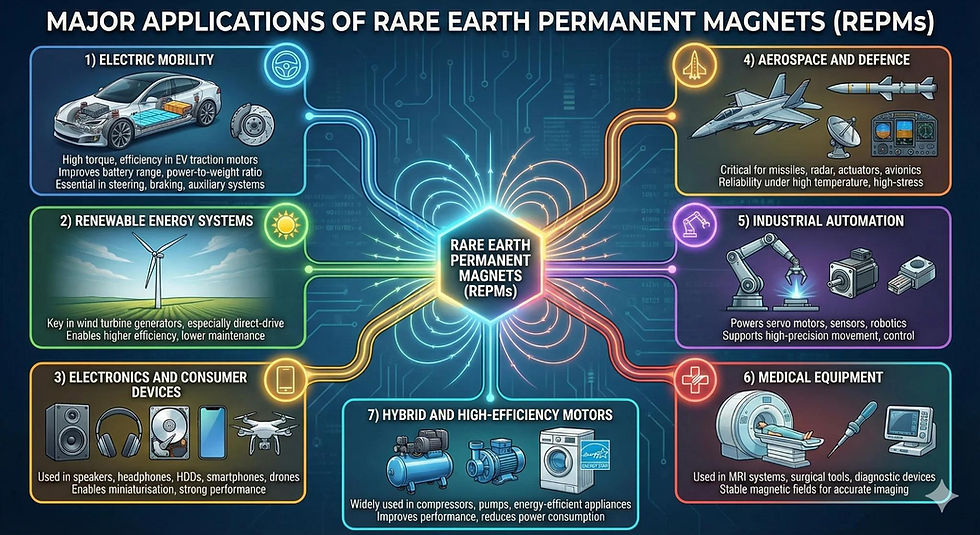
The significance of rare earth free magnets extends beyond scientific curiosity. More than 80% of the world's rare earth processing capacity is concentrated in a limited number of regions, making the supply of critical elements vulnerable to geopolitical tensions and market fluctuations. The extraction and refining of rare-earth elements are also associated with substantial environmental challenges, including large volumes of waste generation and significant ecological footprints. As the global transition toward electrification accelerates, dependence on critical raw materials poses both economic and strategic risks. Developing efficient permanent magnets without relying on rare-earth elements is therefore essential for achieving technological sovereignty, resource security, and sustainable industrial growth.
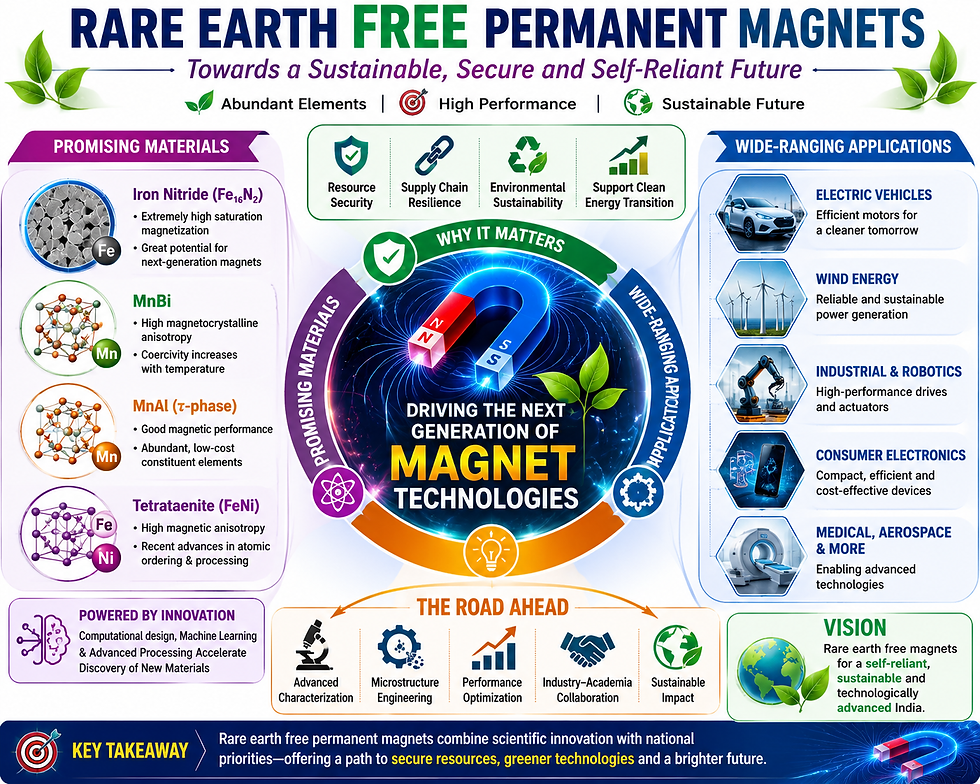
Rare earth free permanent magnets are designed using abundant and environmentally benign elements while retaining the essential magnetic characteristics required for practical applications. Researchers around the world are exploring a wide range of candidate materials, each offering unique advantages and challenges. Among these, iron nitride (Fe₁₆N₂) has attracted enormous attention because of its exceptionally high saturation magnetization, which has been reported to exceed that of conventional iron-based materials. If issues related to phase stability and coercivity can be overcome, Fe₁₆N₂ has the potential to rival or even surpass certain rare-earth magnets in specific applications.
In parallel, manganese-based systems such as MnBi and MnAl have emerged as promising alternatives due to their intrinsic magnetocrystalline anisotropy and relatively abundant constituent elements. MnBi exhibits the unusual characteristic of increasing coercivity with temperature, making it attractive for high-temperature applications. MnAl, particularly in its metastable τ-phase, offers a favorable combination of magnetic performance and low material cost. The development of advanced processing routes, including rapid solidification, mechanical alloying, spark plasma sintering, and additive manufacturing, has significantly improved the magnetic properties of these compounds.
Another exciting avenue of research involves tetrataenite (L1₀-FeNi), a naturally occurring meteoritic phase composed of iron and nickel. Long considered impractical due to the extremely slow cooling rates required for its formation, recent advances in atomic ordering strategies and nonequilibrium processing techniques have renewed interest in this material. Likewise, high-throughput computational approaches, machine learning algorithms, and first-principles calculations are accelerating the discovery of entirely new classes of rare earth free magnetic materials by predicting compositions and structures with optimized magnetic properties before experimental validation.
The potential applications of rare earth free permanent magnets are extensive. Electric vehicles represent one of the most significant markets, where the replacement of rare-earth magnets could dramatically reduce dependence on critical materials and lower manufacturing costs. Wind energy systems could benefit from a more secure and sustainable supply chain for generator components. Consumer electronics, industrial automation, magnetic sensors, robotics, and household appliances are additional sectors where moderate-performance magnets can provide substantial economic advantages. In developing economies, the deployment of affordable permanent magnets could facilitate broader adoption of energy-efficient technologies and support local manufacturing ecosystems.
The pursuit of rare earth free magnets has also stimulated innovation in materials processing and characterization. Researchers are increasingly employing advanced techniques such as synchrotron X-ray diffraction, transmission electron microscopy, atom probe tomography, X-ray photoelectron spectroscopy, Lorentz microscopy, and neutron scattering to unravel the relationships between microstructure and magnetic behavior. Grain boundary engineering, nanocomposite design, exchange coupling strategies, and interface optimization have become critical tools for enhancing coercivity and remanence without compromising magnetization.
Despite remarkable progress, several scientific challenges remain. Achieving the delicate balance between high saturation magnetization, large magnetocrystalline anisotropy, and sufficient coercivity continues to be the central obstacle. Thermal stability, oxidation resistance, scalability of synthesis routes, and cost-effective manufacturing must also be addressed before widespread commercialization becomes feasible. Nevertheless, the rapid growth of interdisciplinary collaborations involving physicists, chemists, materials scientists, computational researchers, and industrial partners suggests that these barriers can be overcome through sustained investment and innovation.
The future of rare earth free permanent magnets is intrinsically linked to global sustainability goals. As nations strive to build resilient supply chains and reduce their environmental footprint, the development of magnets based on abundant elements offers an opportunity to transform the landscape of advanced materials. The field not only addresses critical resource challenges but also provides fertile ground for fundamental discoveries and technological breakthroughs. For students, researchers, entrepreneurs, and policymakers alike, rare earth free magnet research represents a powerful convergence of science, sustainability, and strategic importance.
The transition toward a greener and more self-reliant technological future will depend heavily on our ability to innovate beyond traditional material systems. Rare earth free permanent magnets embody this vision by demonstrating that scientific ingenuity can transform limitations into opportunities. Through continued research and global collaboration, these materials may soon become key enablers of next-generation energy technologies and industrial advancement.
Selected References
Coey, J. M. D. (2012). Permanent magnets: Plugging the gap. Scripta Materialia, 67, 524–529.
Gutfleisch, O., et al. (2011). Magnetic materials and devices for the 21st century. Advanced Materials, 23, 821–842.
Skomski, R., and Coey, J. M. D. (1993). Giant energy product in nanostructured two-phase magnets. Physical Review B, 48, 15812–15816.
Lewis, L. H., Jiménez-Villacorta, F., and Barandiarán, J. M. (2014). Perspectives on permanent magnetic materials for energy conversion and power generation. Metallurgical and Materials Transactions A, 45, 744–748.
Wang, J.-P., et al. Recent advances in Fe₁₆N₂-based permanent magnets and iron nitride technologies.
Gutfleisch, O., et al. (2022). Rare-earth-free permanent magnets: Progress and perspectives. Journal of Physics D: Applied Physics.
McCallum, R. W., et al. (2014). Prospects for non-rare-earth permanent magnets. IEEE Transactions on Magnetics, 50, 2102507.
Comments